

What if the constant, low-grade hum of anxiety in your chest isn’t a problem to be solved, but a part of you simply asking for a softer place to land? You might find yourself moving through your days feeling perpetually on edge, caught in a cycle of fight-or-flight that leaves you emotionally exhausted and disconnected from your own body. It’s a heavy weight to carry. Whether you’re navigating the sharp edges of a sudden trigger or the quiet fog of burnout, the gentle practice of reiki for emotional regulation offers a path back to your centre. It provides a space to breathe.
We believe that finding peace shouldn’t feel like another demanding task on your list. In this guide, you’ll discover how Reiki can help you organize your internal landscape, soothe a weary nervous system, and realize a state of lasting emotional resilience. We will explore how this subtle energy work invites a sense of inner stillness and provides you with the tools to handle life’s fluctuations with more grace and clarity.
Key Takeaways
- Learn how to shift your body from a state of constant fight-or-flight into a restorative rest-and-digest rhythm.
- Discover how reiki for emotional regulation helps you organize your internal landscape, whether you are navigating deep grief or the quiet hum of daily stress.
- Understand the unique resonance between a practitioner and your own energetic state, creating a safe space for your nervous system to find its centre.
- Explore the differences between processing emotions through words and through energy, and how to integrate both into your personal toolkit for well-being.
- Gain clarity on how to approach your sessions with a specific intention to realize lasting resilience and inner stillness.
Understanding Emotional Regulation and Your Energetic Landscape
The world moves quickly. It is easy to feel uncentred, as if you are a leaf caught in a persistent, swirling wind. Whether you are navigating a heavy season of grief or the quiet, grinding hum of chronic stress, your internal landscape can begin to feel cluttered. It becomes difficult to find your footing. Emotional regulation is simply the ability to return to a state of calm after a storm. It isn’t about being “perfect” or avoiding difficult feelings. It is about having a reliable path back to yourself. It is about finding your centre when the world feels loud.
We often think of emotions as purely mental events or thoughts that pass through the mind. However, they are energetic movements within the body. When we look at a comprehensive overview of Reiki, we see a practice rooted in the understanding that energy must flow freely to maintain balance. When emotions get “stuck,” they create a sense of being perpetually on edge. Using reiki for emotional regulation helps to gently nudge this energy, allowing it to move through you rather than becoming a permanent resident in your nervous system. It is a process of clearing the clutter so you can breathe again.
The Weight of the Modern Spirit
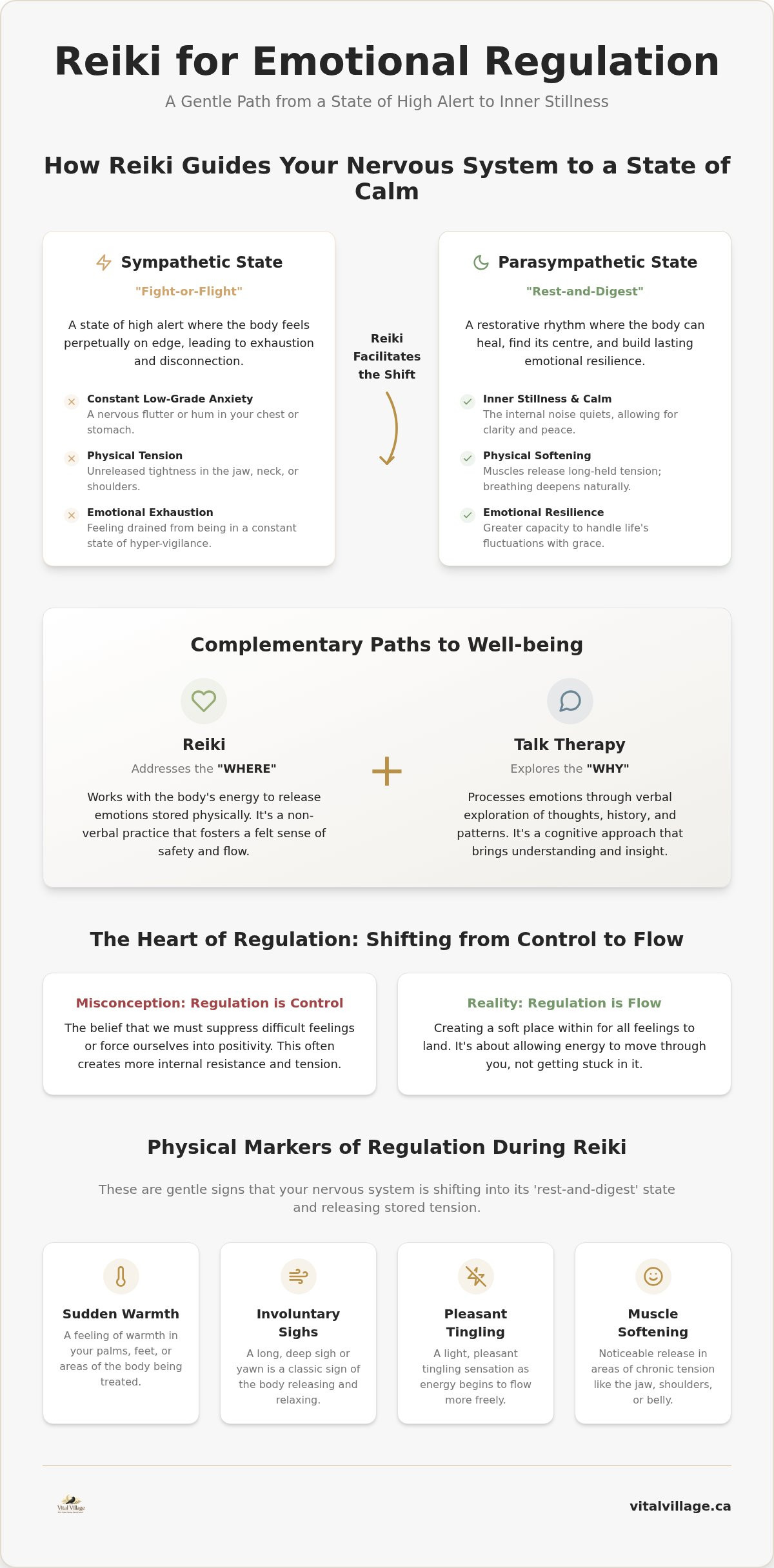
Dysregulation often shows up in subtle, quiet ways. You might feel a tightness in your jaw that won’t release. Perhaps there is a persistent, nervous flutter in your stomach that accompanies you through the day. These are the colours of your daily experience; they paint your world in shades of heavy grey or frantic, vibrating red. While traditional talk therapy is a beautiful tool for processing the “why” of our feelings, it sometimes needs an energetic companion to address the “where” they live in the physical body. Reiki acts as that companion. It holds space for the parts of you that words cannot quite reach. It is a bridge between the mind and the spirit.
Shifting from Control to Flow
There is a common misconception that regulation means control. We often think we must suppress difficult feelings or force ourselves into a state of “positivity” to be stable. This isn’t the case. True stability comes from creating a soft place to land within your own heart. It is about shifting from suppression to flow. By inviting stillness, you begin to realize a new kind of clarity that isn’t forced or manufactured. You don’t have to fight the waves. You just have to learn how to float. This is the heart of reiki for emotional regulation. It is a quiet invitation to be still. To breathe. To remember who you are beneath the noise of a demanding world.
How Reiki Supports Nervous System Regulation
Reiki for emotional regulation is a practice that encourages the body to shift from sympathetic (fight-or-flight) to parasympathetic (rest-and-digest) states. It is a physiological homecoming. When the world feels too loud or demanding, your body often stays in a state of high alert, even when you are trying to rest. Reiki offers a gentle invitation to step down from that ledge. By working with the body’s subtle fields, it activates the parasympathetic nervous system, allowing your heart rate to settle and your breath to find its natural depth. It isn’t about doing. It is about allowing.
The resonance between a practitioner’s calm presence and your own internal state creates a unique container for healing. It is like two tuning forks finding the same note. As the practitioner holds a space of quiet stability, your own system begins to mirror that stillness through a process of energetic entrainment. This vital energy acts as a gentle guide for the body’s natural healing mechanisms. It doesn’t force change; it simply reminds your body how to heal itself. You might feel a sudden warmth in your palms or a pleasant tingling along your spine. You might find yourself letting out a long, involuntary sigh. These are the physical markers of regulation: the softening of muscles and the release of long-held tension.
From Fight-or-Flight to Stillness
Modern life often keeps us in a state of high alert. Our emails, schedules, and social feeds create a chaotic energy that the mind struggles to organize. Reiki helps to quiet this internal noise. It offers a form of spiritual healing for nervous system regulation that works beneath the surface of your thoughts. Whether you are carrying the weight of a busy week or a lifetime of hyper-vigilance, this practice helps you find a sense of daily peace. If you feel ready to explore this quietude, you might consider beginning your journey with a restorative session to see how your own body responds.
The Science of the Subtle Body
Ancient wisdom and modern physiological understanding are beginning to find common ground. While we often look for clinical metrics to validate our experiences, the absence of a lab test doesn’t diminish the deeply felt sense of safety you experience during a session. The practitioner’s role is to hold space. This means creating an environment where your nervous system feels safe enough to drop its guard and realize a state of true relaxation. In this sanctuary, your body can finally begin the work of recalibration. It is a return to balance. It is a return home. Through reiki for emotional regulation, you learn that safety is not something you have to build; it is something you can return to.
Comparing Reiki with Other Emotional Support Modalities
Healing is rarely a straight line. It is more like a mosaic, where different pieces come together to create a picture of wholeness. When evaluating where reiki for emotional regulation fits into your personal toolkit, it is helpful to see it as a partner rather than a replacement for other forms of support. Whether you are already working with a therapist or you are just beginning to explore your inner world, Reiki provides a unique layer of care. While psychotherapy focuses on the narrative and the mental processing of our experiences, Reiki addresses the energetic residue those experiences leave behind. It offers a non-verbal avenue for release. It allows the body to let go of what the mind isn’t yet ready to put into words.
University research into Reiki suggests that the practice can be remarkably effective in reducing anxiety and improving overall well-being. This doesn’t mean you must choose between a clinical approach and a spiritual one. In fact, many find that professional reiki treatment acts as a grounding anchor that makes the work of therapy feel more accessible. It creates the internal space needed to face difficult truths with a bit more grace. It is a soft place to land when the mental work feels heavy.
A Companion to Traditional Therapy
Sometimes, words simply aren’t enough to reach the depth of a feeling. You might have spent years talking through a specific memory, yet the physical sensation of panic still rises in your chest. This is where energy work shines. It can ‘unstick’ emotions that have been intellectually understood but not yet fully felt or released from the body’s tissues. It is a collaborative process. One modality clears the mind, while the other clears the path for the spirit to move freely again. It is a way to honour the body’s wisdom without needing to explain it.
Akashic Reiki: A Soul-Level View of Emotion
For those seeking a deeper understanding, Akashic Reiki offers a unique perspective. You might wonder, akashic records what are they and how do they help? Think of them as a soul-level map. While standard reiki for emotional regulation focuses on calming the current storm, the Akashic perspective helps you understand the weather patterns of your life. It looks at the ‘why’ behind recurring triggers. This isn’t just surface-level calming. It is a journey toward soul-level healing that addresses the root of your emotional landscape, helping you realize a stability that feels both ancient and new. It is about soul-path alignment and finding clarity in the silence.
How to Integrate Reiki into Your Emotional Regulation Journey
Integration isn’t about adding another chore to your already full day. It is about creating a sanctuary within your existing routine. When using reiki for emotional regulation, the ritual begins long before you lie down for your session. It starts with a quiet decision to show up for yourself with honesty and kindness. This isn’t a clinical procedure; it’s a gentle conversation between your body and your spirit. By approaching each session with intention, you allow the practice to become a reliable anchor in your life.
- 1. Setting the intention: Take a moment to breathe before you begin. Ask yourself what part of your emotional landscape needs tending right now. Is it a sharp edge of anger? Or perhaps a heavy fog of exhaustion that won’t lift?
- 2. Preparing the space: Create an environment of silence and comfort. This might mean a soft blanket, dim lights, or simply a few minutes of quiet reflection. Your physical surroundings should reflect the peace you are seeking.
- 3. The session: During the treatment, your only job is to be. Allow the gentle flow of energy to move through blocks, trusting that your body understands how to find its own way back to balance.
- 4. Integration: This is the most vital part of the journey. The stillness you cultivate during a session shouldn’t stay in the room. Whether you are stepping out into the biting cold of a Canadian winter or the frantic energy of a busy summer, carry that quiet pocket of peace with you. Realize that the stability you’ve found is now part of your internal architecture.
Preparing Your Internal Space
Before your treatment, focus on grounding your energy. Drink plenty of water, as hydration helps the energy move more fluidly through your system. You might also find that journaling helps you realize what you are truly ready to release. Write down your thoughts without judgment or the need to organize them perfectly. Approaching the session with a “beginner’s mind” allows you to let go of expectations. Just be present with whatever arises.
Post-Session Integration and Care
The 24 hours following a treatment are a crucial time for emotional processing. Your system is still echoing with the resonance of the work. You might feel more sensitive, or perhaps profoundly relaxed. Both are normal responses. This is the time to avoid heavy social obligations or loud environments. Instead, choose gentle movement. A slow walk through a local park can help ground the energy. Notice the subtle shifts in how you handle triggers. You might find you have a split second of extra space before you react. That space is where your resilience lives. Reiki for emotional regulation is a cumulative practice that builds on itself over time.
Professional Therapeutic Reiki: Your Path to Lasting Resilience
Choosing a practitioner is an act of trust. It is about finding a resonance that allows you to feel truly safe. When you seek out reiki for emotional regulation, you aren’t looking for a distant authority to “fix” you. You are looking for a wise companion. A peer who understands that the path to stability is rarely a straight line. This relationship is the foundation of the work. It creates a container where you can let down your guard without fear of judgment. In this space, you are not a patient to be managed, but a person to be held in quiet acceptance.
The quality of this container is often reflected in the practitioner’s own dedication to the craft. We believe in the profound value of advanced reiki training in Canada as a means of ensuring emotional safety. This level of mastery isn’t just about technique; it is about the capacity to hold a steady, compassionate presence for others. It ensures that the space remains clear and grounded, regardless of how intense your internal storm might feel. Whether you are navigating a season of deep transition or simply trying to find your centre in a noisy world, the expertise of your guide matters. It provides the stability you need to explore your own inner landscape with confidence.
The Vital Village Metaphysical approach begins with the nervous system. We see regulation as the essential foundation of all energy work. Without a settled system, clarity remains out of reach. Our approach blends the grounded practice of Therapeutic Reiki with the expansive insights of Akashic wisdom. This combination allows us to address the immediate sensations of stress while also honouring your soul’s unique rhythm. Your journey with us is entirely non-prescriptive. We don’t dictate how you should feel or how quickly you should progress. We simply offer a soft place to land. A sanctuary where your body and spirit can finally realize a state of deep balance.
Beginning your journey doesn’t require a massive commitment. It often starts with a single, gentle session. This initial step allows you to experience the resonance of reiki for emotional regulation firsthand. Over time, consistent emotional “maintenance” becomes a way to fortify your resilience. It is like tending a garden; regular care ensures that the soil remains rich and the roots grow deep. As you move forward, you will find that the stillness you cultivate here begins to colour every aspect of your life. You’ll handle triggers with more grace. You’ll find clarity in the silence. We invite you to step into this space of quiet acceptance. We are here to walk beside you, holding space for the peace you deserve.
Realizing Your Internal Sanctuary
Emotional stability is not a fixed destination but a gentle, ongoing conversation with your own spirit. Throughout this guide, we have explored how reiki for emotional regulation serves as a bridge between a chaotic external world and the quiet resonance of your heart. By prioritizing nervous system regulation, you move beyond simply managing stress. You begin to organize your internal landscape in a way that allows for lasting resilience. Whether you are navigating a season of heavy transition or seeking a moment of clarity, this practice offers the tools to handle life’s triggers with profound grace.
Our practitioners serve as compassionate, gentle guides for your healing journey. We bring a deep expertise in nervous system regulation and a commitment to national Canadian spiritual training standards to every session. You deserve a sanctuary where you feel seen, supported, and safe to simply be. Your journey toward stillness is a personal one, and there is no rush to find every answer today. It is enough to simply begin.
Take a deep breath and listen to the quiet pull of your own intuition. A softer, more balanced way of living is waiting for you. We are here to offer that soft place to land whenever you are ready to come home to yourself.
Frequently Asked Questions
Can Reiki help with acute emotional outbursts or only chronic stress?
Reiki is effective for both acute emotional outbursts and the quiet, persistent hum of chronic stress. While chronic stress requires consistent tending to reorganize your internal landscape, an acute outburst is often a sign that your system has reached its limit and needs immediate grounding. A session can act as a gentle circuit breaker, helping you return to a state of safety when you feel completely uncentred.
How many sessions are typically needed to feel a change in my emotional regulation?
Most individuals notice a subtle shift in their internal state after just one session. However, for lasting reiki for emotional regulation, we often suggest a series of three to four treatments to help your nervous system learn how to maintain its own balance. This cumulative approach allows the body to build a deeper familiarity with the state of relaxation, making it easier to return to that centre in your daily life.
Do I need to believe in energy healing for Reiki to help me regulate my emotions?
You don’t need to believe in energy healing for the practice to be effective. Reiki works directly with your body’s physiological responses, encouraging the nervous system to shift into a restorative parasympathetic state. Whether you approach the session with skepticism or deep faith, your body will naturally respond to the invitation to rest and recalibrate. The felt sense of safety is a physical experience, not just a mental one.
Is it normal to feel emotional or cry during a Reiki session?
It is entirely normal and quite common to feel emotional or cry during a session. These releases are a sign that your body is finally letting go of energy that has been held in a state of tension or suppression. We view these moments as a beautiful and necessary part of the healing process. We are here to hold a safe, non-judgmental space for whatever feelings need to surface and pass through.
How does Reiki compare to meditation for calming the nervous system?
While both are excellent for calming the nervous system, Reiki is a passive practice where you are supported by a practitioner’s presence. Meditation often requires a level of mental discipline that can be difficult to achieve when you are highly dysregulated. Reiki allows you to simply receive, making it a “soft place to land” when your mind feels too loud or chaotic for silent, self-guided meditation.
Can I use Reiki alongside my current psychotherapy or counselling sessions?
Yes, Reiki is a wonderful companion to psychotherapy or counselling. While talk therapy helps you process the narrative and “why” of your life, reiki for emotional regulation addresses the energetic and physical sensations that often remain stuck in the body’s tissues. Combining the two creates a more holistic path to wholeness, as it allows you to process your experiences through both words and energy.
What should I wear to a Reiki session to ensure I feel most comfortable?
You should wear loose, comfortable clothing that allows you to relax fully without restriction. Natural fibres like cotton or linen are often preferred for their breathability, but the most important thing is that you feel at ease. You will remain fully clothed throughout the treatment, so choose items that won’t feel tight or distracting when you are lying down for an extended period of time.
Will Reiki help me realize my emotional triggers more clearly?
Reiki helps you realize your emotional triggers by creating a sense of inner stillness and clarity. When the constant noise of stress is lowered, you become a more observant witness to your own internal landscape. This heightened awareness allows you to notice the subtle rise of a trigger before it becomes an overwhelming storm, giving you the space to respond with more grace and intention.