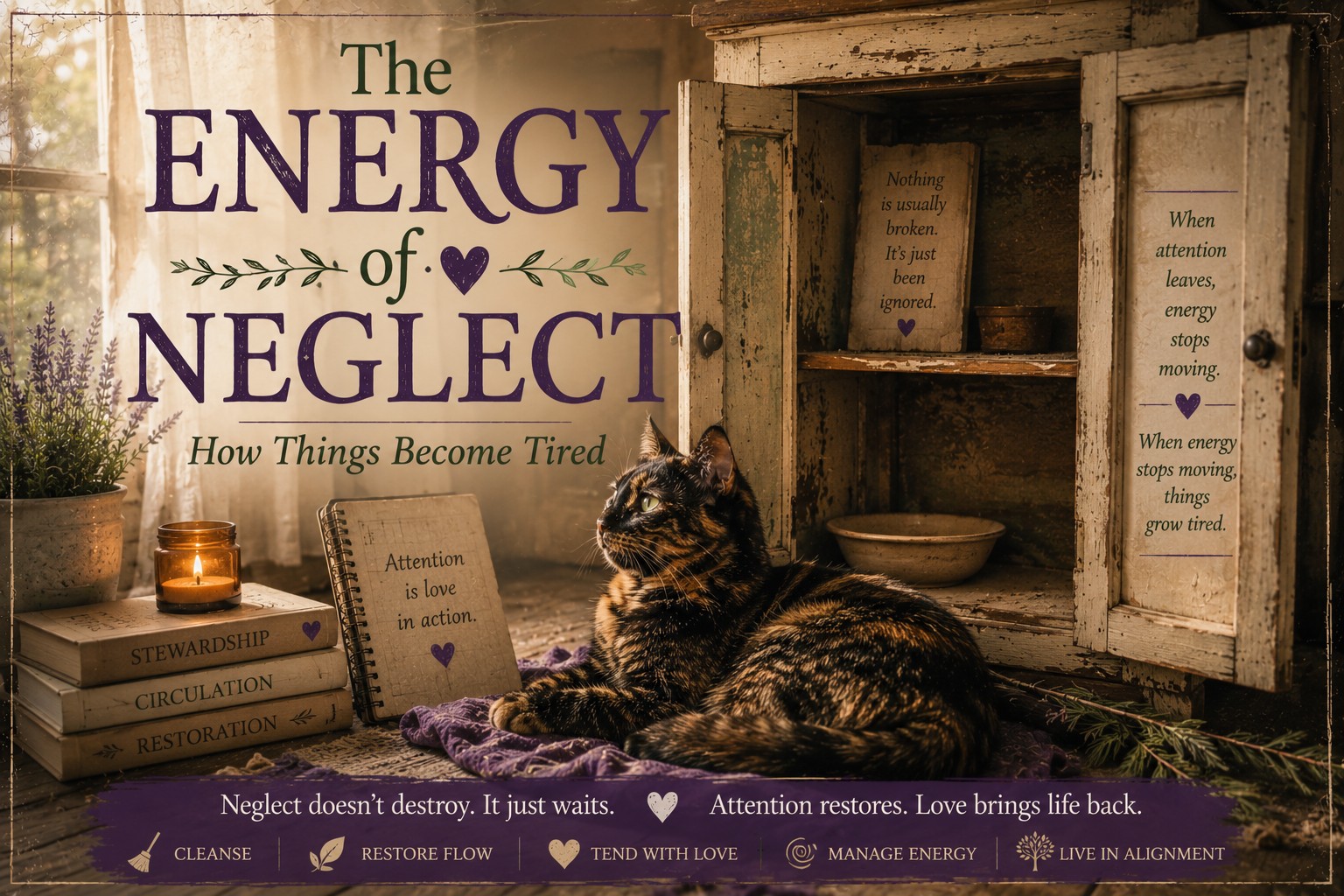
The Energy of Neglect
How Things Become Tired
I used to think things broke.
Now I think they slowly become tired.
There’s a difference.
Broken implies a dramatic event.
A crash.
A crisis.
A single moment when everything changes.
But tiredness arrives quietly.
It settles in over months and years.
One postponed project.
One ignored conversation.
One unopened cupboard.
One dream we keep meaning to get back to.
Until one day we look around and wonder how things got this way.
Nothing Happened
One of the biggest lessons I’ve learned is that neglect rarely comes from bad intentions.
Most of us don’t wake up and decide to stop caring.
We get busy.
We become overwhelmed.
We tell ourselves we’ll deal with it next weekend.
Next month.
When life settles down.
When we have more money.
When we have more energy.
When the timing is right.
And in the meantime, life quietly waits for us.
The Tired Cupboard
This realization hit me while opening the cupboards in our summer home.
Structurally, they were perfectly fine.
The hinges worked.
The shelves were solid.
The doors opened and closed.
But something felt off.
The paint inside was worn.
The surfaces looked dull.
The bottoms needed cleaning and care.
The cupboards weren’t broken.
They were tired.
And somehow that felt deeply familiar.
We Become Tired Too
People do this as well.
Not because they’re weak.
Because they’ve been carrying too much for too long.
A person can look perfectly functional on the outside while quietly feeling worn down inside.
They keep showing up.
They keep paying bills.
They keep smiling.
But their inner shelves are cluttered with old worries, postponed grief, inherited expectations, and responsibilities they’ve forgotten how to put down.
From the outside, everything looks fine.
From the inside, they’re exhausted.
Energy Stops Moving
I’ve come to believe that healing is often less about fixing and more about restoring circulation.
Think of a stream.
When water flows, it stays fresh.
When it stagnates, things begin to collect.
Leaves settle.
Mud builds up.
Algae grows.
The stream isn’t bad.
It simply needs movement again.
The same is true for our lives.
Attention is movement.
Honesty is movement.
Forgiveness is movement.
Cleaning a room is movement.
Taking a walk is movement.
Having the difficult conversation is movement.
Even a deep breath can begin to shift stagnant energy.
The Weight of “Later”
Neglect is rarely intentional.
More often, it’s made up of tiny promises to ourselves.
“I’ll get to it later.”
“I don’t have time today.”
“It isn’t that important.”
But every postponed decision takes up space.
Every unresolved task quietly asks for attention.
Every unfinished conversation hums in the background.
Over time, those whispers become emotional clutter.
Not because they’re impossible to deal with.
Because they remain open loops.
___
The Little Things Matter
One afternoon at the summer home, Dave was working on some plumbing.
He hates plumbing.
The job was stressful, and at one point he came in and spoke to me in a way that simply wasn’t aligned with who we are.
In the moment, I let it pass.
I knew he was frustrated.
But later, when he came in to freshen up, I gently told him that I didn’t appreciate the way he’d spoken to me.
Not because I wanted an argument.
Because I didn’t deserve it.
And neither of us deserved to carry that energy any further.
He became quiet for a moment.
Then he apologized.
He explained how stressful the plumbing had been.
I understood completely.
Stress is real.
But I also reminded him that how we treat each other matters, especially when we’re under pressure.
Then we let it go.
No grudge.
No resentment.
No story to carry forward.
Just a small repair made while it was still small.
I’ve realized that’s part of stewardship too.
If something is affecting even one person, it matters.
Because unattended moments have a way of accumulating.
A single sharp comment can become distance.
Distance can become silence.
Silence can become a wall.
Not because anyone intended it.
Simply because no one restored the flow.
Sometimes healing isn’t dramatic at all.
Sometimes it’s a quiet conversation that says,
“That didn’t feel good. Let’s do better.”
And then both people return to who they really are.
Stewardship Is a Practice
One of the greatest gifts my tortoiseshell cat Pippi gave me was the habit of paying attention.
Every spring she insisted on inspecting every cupboard and closet in our summer home.
She wasn’t worried.
She was curious.
Present.
Engaged.
She reminded me that caring for a place means looking at it.
Not once.
But over and over again.
The same is true of our lives.
Our relationships.
Our bodies.
Our dreams.
They don’t need constant fixing.
They need regular tending.
The Quiet Return of Life
The beautiful thing about tired things is that they often don’t need to be replaced.
They need to be loved.
A coat of paint.
A careful washing.
Fresh air through an open window.
A heartfelt apology.
An afternoon of rest.
A difficult truth spoken with kindness.
Attention has a way of bringing life back.
Sometimes all a neglected thing has been waiting for is someone willing to notice it again.
Walking Between Worlds
I’ve started to see this pattern everywhere.
In homes.
In finances.
In health.
In businesses.
In spiritual practice.
Everything responds to care.
Everything benefits from circulation.
Everything flourishes when energy is allowed to move.
Walking Between Worlds isn’t just about sensing the unseen.
It’s about recognizing that the same principles govern every part of life.
The outer world mirrors the inner world.
And both are quietly asking the same question:
What deserves your attention today?
Maybe That’s the Secret
Maybe the opposite of neglect isn’t perfection.
Maybe it’s presence.
Maybe healing doesn’t begin with a grand breakthrough or a dramatic transformation.
Maybe it begins the moment we stop walking past the things that have been patiently waiting for our care.
A room.
A relationship.
A body.
A dream.
A cupboard.
Or even a part of ourselves.
Sometimes the most loving thing we can do is simply pause, open the door, and say,
“I see you now.”
And that, more than anything, is what starts to bring life back.
Thank you for reading.
I’d love to hear your thoughts in the comments.
What in your life has been quietly asking for your attention, not because it’s broken, but because it’s simply grown tired?