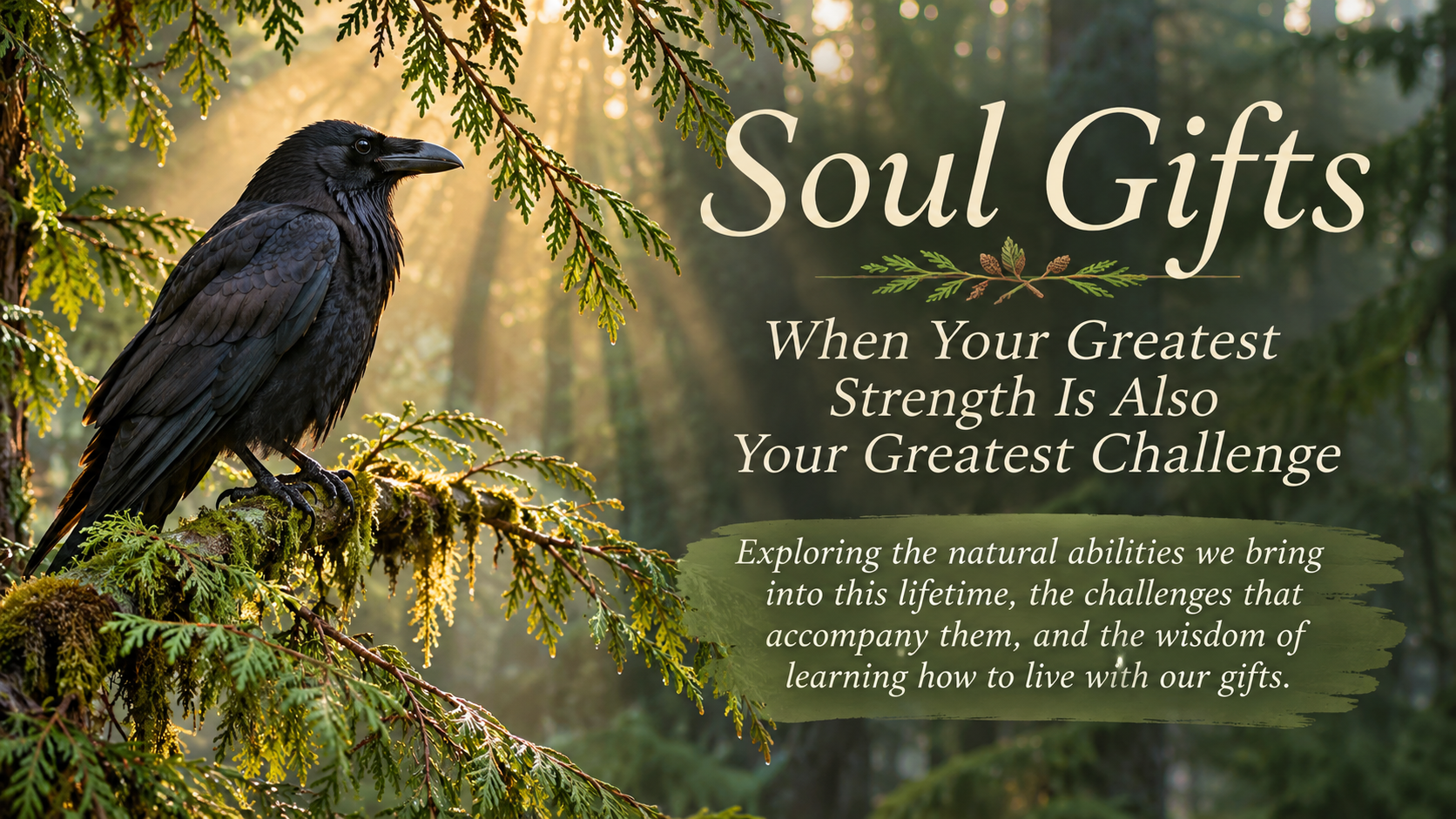
Soul Gifts: When Your Greatest Strength Is Also Your Greatest Challenge
When Your Greatest Strength Is Also Your Greatest Challenge
Explore the natural abilities we bring into this lifetime, the challenges that come with them, and the wisdom of learning to live with our gifts.
Have you ever wondered whether the thing you’ve struggled with your entire life might actually be connected to one of your greatest gifts?
Perhaps you’ve always been told you’re too sensitive.
Too independent.
Too curious.
Too outspoken.
Maybe you ask too many questions, feel things too deeply, or notice things that everyone else seems perfectly content to ignore.
Perhaps you’ve spent years trying to become a little more like everyone else.
A little easier to get along with.
A little less complicated.
And yet, no matter how hard you try, certain qualities remain.
What if some of those characteristics aren’t things you’re supposed to eliminate?
What if they’re abilities you haven’t entirely learned how to live with yet?
This is one of the subjects I find particularly fascinating when exploring soul gifts through the Akashic Records.
Because sometimes our greatest challenges aren’t separate from our gifts.
Sometimes they’re deeply connected.
What Are Soul Gifts?
Within the Akashic Records teachings I work with, soul gifts are abilities, qualities, and natural tendencies associated with the soul.
You can think of them as characteristics we’ve developed through spiritual experiences, previous lifetimes, or the soul’s ongoing journey of learning and evolution.
Some gifts appear early in life.
A child may demonstrate extraordinary compassion, creativity, curiosity, or sensitivity long before anyone has encouraged those qualities.
Other gifts may emerge gradually, particularly as we move through experiences that challenge us to develop new abilities.
And some may remain largely unrecognized until much later in adulthood.
Of course, there are many ways to understand natural abilities. Genetics, temperament, upbringing, education, and life experiences all influence the skills and characteristics we develop.
The Akashic Records offer a spiritual framework for exploring these qualities, not a scientifically established method for determining their origins.
But what I appreciate about this exploration is the chance to see ourselves differently.
Instead of asking, “Why am I like this?”
We might begin asking, “How can I work with this part of myself more consciously?”
And that can be a very powerful shift.
The Gifts We Don’t Recognize
One of the most interesting things about natural abilities is that we often don’t recognize them as anything special.
When something comes easily to us, we assume it must come easily to everyone.
Imagine someone who can walk into a room and immediately recognize that something is wrong.
They notice the uncomfortable silence between two people.
They recognize when someone is upset despite their cheerful expression.
They sense when a conversation isn’t entirely honest.
To them, this may seem perfectly ordinary.
They’ve been noticing these things their entire lives.
But another person might walk into that same room and notice absolutely nothing unusual.
Neither person is necessarily better or more spiritually developed.
They simply perceive and process their surroundings differently.
Maybe this heightened sensitivity is a possible soul gift.
But here’s where it gets interesting.
The person who notices everyone’s emotions may also struggle to separate their own feelings from the emotional atmosphere around them.
They might become exhausted in crowded places.
They may feel responsible for making everyone comfortable.
And they might spend years believing their sensitivity is a weakness.
The very quality that helps them understand others can also make life harder.
Until they learn how to work with it.
When Compassion Becomes Self-Abandonment
Let’s consider someone whose natural gift is compassion.
They can recognize the goodness in almost anyone.
Even when someone behaves badly, they instinctively wonder what that person has experienced.
Were they hurt as a child?
Have they experienced rejection?
Are they frightened?
What do they love?
What are they trying to protect?
They look for love because understanding what someone loves often helps explain their behaviour.
This can be an extraordinary ability.
It allows people to connect across differences, recognize suffering, and offer understanding where others might offer judgment.
But what happens when compassion has no boundaries?
The compassionate person may remain in relationships that are no longer healthy.
They may repeatedly excuse harmful behaviour because they understand where it comes from.
They might become so focused on another person’s healing that they forget their own needs.
And eventually, their beautiful gift becomes exhausting.
Not because compassion is a problem.
But because compassion needs discernment.
Understanding someone’s pain doesn’t make us responsible for carrying it.
The gift is the ability to recognize and respond to suffering.
The lesson may be learning how to offer compassion without abandoning ourselves.
When Discernment Makes It Difficult to Belong
Now let’s explore a different kind of gift.
Imagine someone who has always been able to recognize inconsistencies.
They notice when people say one thing and do another.
They recognize when an organization claims to value fairness but operates according to practices that don’t reflect those values.
They see outdated systems, unnecessary complications, and problems that everyone else seems to have accepted as normal.
And they ask questions.
Why are we doing things this way?
Who benefits from this arrangement?
Is there a better way?
Are we actually accomplishing what we say we’re trying to accomplish?
Sometimes those questions lead to meaningful improvements.
An inefficient process gets corrected.
An unfair expectation gets challenged.
A neglected space receives attention.
Someone who hasn’t been heard finally has an opportunity to speak.
But this ability can have a difficult side.
People don’t always appreciate having familiar practices questioned.
Organizations may resist change.
And someone who notices inconsistencies may find it difficult to remain comfortable in environments where those inconsistencies are repeatedly ignored.
Eventually, they may begin to feel like an outsider.
Too questioning.
Too independent.
Too unwilling to simply go along.
They may even begin wishing they could stop noticing so much.
But perhaps the problem isn’t their ability to recognize what needs attention.
Perhaps the challenge is learning when to act, when to accept what they cannot control, and when an environment is no longer suitable for them.
Discernment is a gift. Feeling responsible for correcting everything we discern can become a burden.
And learning the difference may be part of developing that gift.
The Difference Between a Gift and a Responsibility
This is something I think deserves much more attention in spiritual teachings.
Having an ability doesn’t mean we’re obligated to use it constantly.
Someone who is naturally good at comforting others doesn’t have to become everyone’s emotional support system.
Someone who recognizes problems doesn’t have to solve every problem they encounter.
Someone who can teach doesn’t have to spend their entire life teaching.
And someone with a gift for healing isn’t responsible for making everyone well.
Sometimes we confuse our abilities with our obligations.
We think that because we can do something, we should.
But our gifts are part of who we are.
They aren’t contracts requiring us to sacrifice our well-being.
I think this distinction becomes especially important for people who work in helping professions or spiritual practices.
We can offer insight, encouragement, education, and support.
But we cannot live another person’s life for them.
We cannot make their choices.
We cannot determine how quickly they learn, change, or heal.
And we cannot guarantee the outcome of their journey.
Our responsibility is to work with integrity, recognize our limitations, and honour the relationship’s boundaries.
The rest belongs to the person walking their own path.
When a Gift Needs the Right Environment
Here’s another possibility worth considering.
What if some of the difficulties we associate with our natural characteristics are actually signs that we’re trying to express those characteristics in environments that don’t support them?
Imagine a highly creative person working in a position where every minute is scheduled, and every task must be performed exactly the same way.
Or an independent thinker working in an organization that discourages questions.
Or a deeply sensitive person spending their days in an environment filled with constant conflict.
They might begin believing something is wrong with them.
Perhaps they’re too restless.
Too emotional.
Too easily bored.
But put that same person in an environment where their abilities are valued, and their experience may change dramatically.
The creative person has opportunities to develop new ideas.
The independent thinker is encouraged to identify improvements.
The sensitive person has enough space and support to manage their energy.
The person hasn’t necessarily changed.
The environment has.
And sometimes that makes an enormous difference.
This doesn’t mean we should expect every environment to accommodate every preference.
We all need flexibility, patience, and the ability to work with people who are different from us.
But there is a difference between healthy adaptation and continually forcing ourselves into circumstances that undermine our wellbeing.
Perhaps one of the most important things we can learn about our gifts is where they can flourish without consuming us.
Can Soul Gifts Change Over Time?
I believe our relationship with our gifts changes as we grow.
An ability that once seemed overwhelming may become easier to manage with experience.
A quality we once considered a weakness may become one of our greatest strengths.
And sometimes our priorities change so much that we begin expressing familiar gifts in entirely new ways.
Consider someone who has spent decades advocating for people within organizations.
They may eventually become tired of institutional politics and constant confrontation.
Does that mean they’ve lost their gift for recognizing injustice or helping others?
Not necessarily.
Perhaps they begin expressing that same ability through writing, teaching, mentoring, or creating resources that help people understand their options.
The underlying quality remains.
But the expression evolves.
A natural teacher might move from classrooms to books.
A healer might move from intensive one-on-one work to teaching others.
A creative person might discover a completely different medium later in life.
And someone who has always been drawn to improving difficult environments may eventually decide to create a peaceful environment of their own.
Our gifts don’t have to stay expressed the same way forever.
Sometimes growth involves recognizing that we’re allowed to change how we contribute.
What About Gifts We Haven’t Discovered Yet?
Within the Akashic Records, we may also explore the idea of gifts that haven’t been fully developed or expressed in this lifetime.
Perhaps someone has always been drawn to music but never had an opportunity to learn.
Perhaps they’ve felt curious about healing, teaching, writing, or working with animals but have never explored those interests.
Maybe they have a natural ability to recognize patterns but have spent years in work that doesn’t allow them to use it.
Sometimes a gift isn’t hidden because it’s mysterious.
Sometimes it’s hidden because life has been busy.
We’ve been raising families, earning a living, managing responsibilities, and doing what was necessary to get through the day.
And somewhere along the way, we stopped exploring.
One of the lovely things about getting older is that we may begin giving ourselves permission to become curious again.
We try something new.
We take a class.
We discover an interest we never knew we had.
We begin creating simply because it brings us joy.
And occasionally, we discover an ability that feels surprisingly natural.
Whether we understand that ability as a soul gift, a previously unexplored talent, or a combination of both, the discovery can be wonderful.
It reminds us that we’re never entirely finished becoming ourselves.
How Do We Explore Soul Gifts in the Akashic Records?
When exploring soul gifts through an Akashic Records reading, we may investigate the qualities and abilities associated with a person’s soul profile.
We can look at natural tendencies, spiritual interests, and gifts the person feels drawn to develop.
We may also explore how particular abilities relate to recurring challenges.
For example, someone with a strong gift for compassion might explore their relationship with boundaries.
Someone with a gift for leadership might examine how they respond to responsibility and control.
Someone with heightened sensitivity might explore ways of managing their energy.
And someone with a gift for recognizing patterns might consider how to use that discernment without becoming overwhelmed by everything they notice.
The purpose isn’t to assign a fixed identity or tell someone what they’re destined to become.
It’s to create an opportunity for deeper self-understanding.
I also think it’s important to approach spiritual information with discernment.
Not every interpretation will resonate.
Not every difficulty needs a spiritual explanation.
And discovering a possible soul gift doesn’t replace the practical work of developing skills, understanding ourselves, and making conscious choices.
The most useful insights are the ones that help us live more thoughtfully and compassionately.
Perhaps Your Greatest Gift Isn’t Meant to Make Life Easy
I think we sometimes imagine that discovering our soul gifts will make everything simpler.
We’ll finally understand our purpose.
We’ll recognize our abilities.
We’ll know exactly what we’re supposed to do.
And suddenly, life will fall beautifully into place.
But I don’t think it always works that way.
Sometimes recognizing a gift raises new questions.
How do I use this without exhausting myself?
How do I honour my sensitivity without becoming overwhelmed?
How do I remain compassionate without taking responsibility for everyone else’s healing?
How do I recognize injustice without carrying the weight of every unfair situation?
How do I honour my independence while building relationships and commitments that last?
These aren’t necessarily problems to eliminate.
They may be questions we continue exploring as we grow.
And perhaps the goal isn’t to perfect our gifts.
Perhaps it’s to develop a healthier relationship with them.
To recognize their value.
To understand their limitations.
To learn when to use them and when to rest.
And to find environments, relationships, and ways of living that allow us to express them without losing ourselves.
Coming Home to the Gifts You Already Have
I wonder how many people have spent their entire lives apologizing for qualities they were never meant to be ashamed of.
The sensitive child who became an adult constantly trying not to feel so much.
The independent thinker who learned to keep quiet.
The creative person who decided their imagination wasn’t practical.
The compassionate person who became exhausted trying to help everyone.
The curious person who was repeatedly told to stop asking questions.
What if we approached these qualities with curiosity instead of criticism?
What if we stopped asking how to become less of ourselves and began asking how to live more comfortably with who we are?
Perhaps sensitivity needs boundaries.
Perhaps independence needs connection.
Perhaps discernment needs patience.
Perhaps compassion needs self-respect.
Perhaps creativity needs room to breathe.
And perhaps some of the qualities we’ve struggled with most are connected to abilities we’ve never fully appreciated.
That doesn’t mean every difficulty is secretly a gift.
But it does mean we can become curious about the relationship between our strengths and our struggles.
Because the goal of exploring our soul gifts isn’t to become someone extraordinary.
It’s to recognize the value of who we already are, develop the wisdom to use our abilities well, and create a life where those abilities can flourish.
And perhaps that’s one of the most beautiful discoveries we can make within the Akashic Records.
We don’t always need to become someone new. Sometimes we simply need to learn how to take better care of the person we’ve always been.
Discover Your Soul Gifts Through the Akashic Records
Exploring your soul gifts is one of the fascinating subjects we can investigate during an Akashic Records reading.
Whether you’re curious about your natural abilities, spiritual development, recurring life patterns, or the gifts you may not have fully recognized, an Akashic Records reading offers a space for spiritual reflection and exploration.
You may also enjoy the earlier articles in this series:
- What Actually Happens During an Akashic Records Reading?
- 13 More Things You Can Discover in Your Akashic Records
- Your Soul Profile: Who Were You Before the World Told You Who to Be?
I offer private Akashic Records readings online via Zoom, along with classes for those called to learn how to access and work with the Records themselves.
Visit Vital Village Metaphysical to explore readings, spiritual teachings, and upcoming classes.
Ready to Explore Your Akashic Records?
I offer both in-person sessions in Winnipeg and online appointments for clients across Canada and internationally. (Make sure to mention in the booking notes if you need a Zoom connection.)
Book your Akashic Records Session here: 👉 Book Here