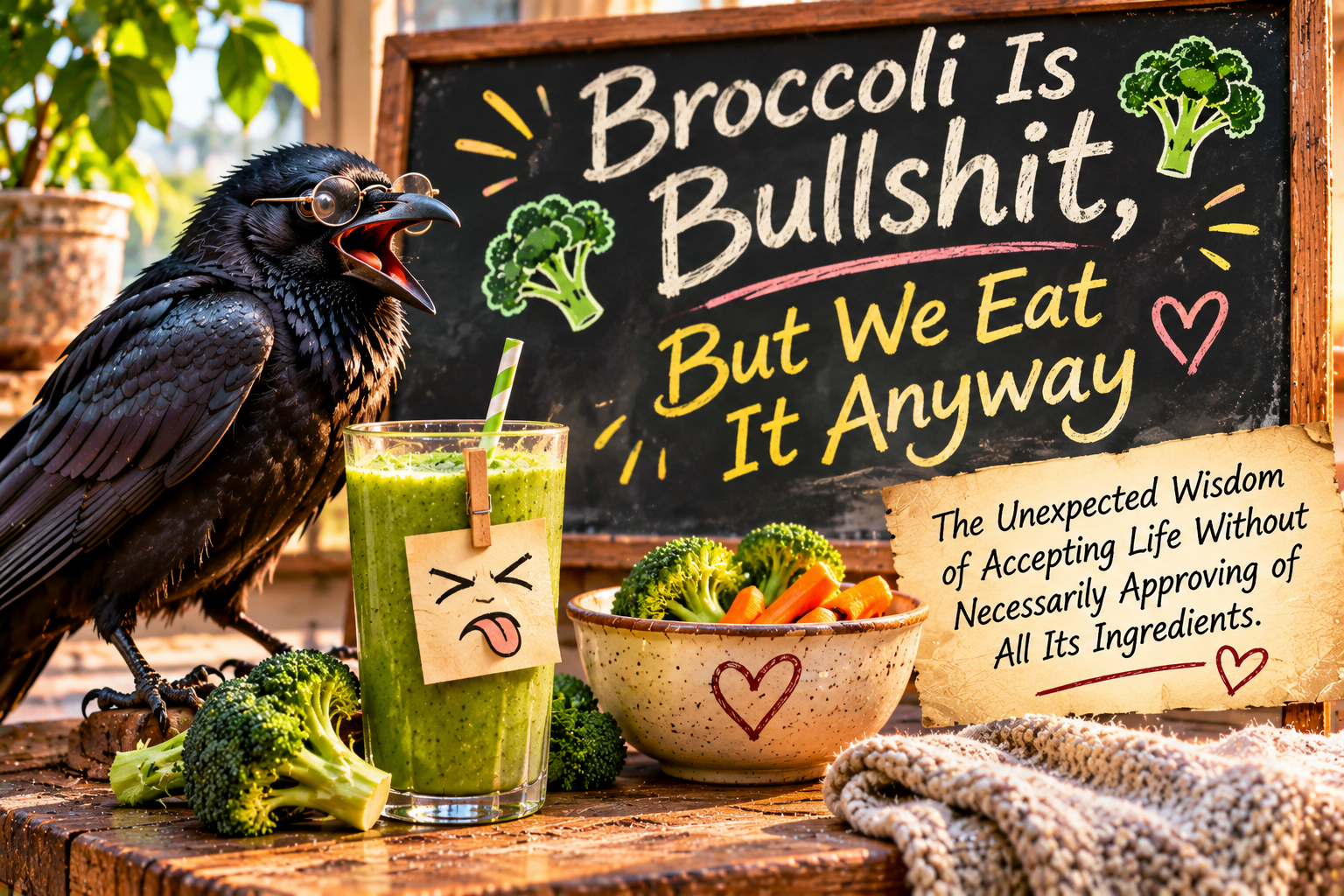
Broccoli Is Bullshit, But We Eat It Anyway
The unexpected wisdom of accepting life without necessarily approving of all its ingredients.
My grandchildren once made a rather profound philosophical declaration.
“Broccoli is bullshit.”
Now, as a grandmother with a background in nutrition, I could have launched into a rather impressive explanation of the nutritional benefits of broccoli.
I could have discussed antioxidants, vitamins, minerals, and the importance of eating a variety of vegetables.
But there was something about the conviction with which this statement was delivered that made me laugh.
And the funniest part?
They eat it anyway.
They haven’t organized a protest. They haven’t demanded that broccoli be permanently removed from the family menu. They haven’t decided that their grandmother is a terrible human being for putting it on their plates.
They’ve simply established their position on broccoli.
And then they get on with their lives.
I’ve been thinking lately that there might be something rather wise about that.
Apparently, It Runs in the Family
My daughter once told me that one of the things she’d learned from watching me growing up was that something didn’t necessarily have to taste good for us to consume it.
There were plenty of green smoothies in our house when she was growing up.
Now, I understood the nutritional benefits of green smoothies. I knew how much better I felt when I drank them regularly. I had more energy, and I enjoyed the benefits of getting all that lovely green goodness into my body.
What I didn’t particularly enjoy was the experience of getting it there.
My daughter recalled watching me scrunch up my face, seemingly hold my breath, and down the entire smoothie as quickly as humanly possible.
This was usually followed by a rather expressive “BLEHHHHHH!” and the immediate relocation of the offending glass to the kitchen sink.
There was no lingering over the beverage, appreciating its delicate notes of spinach.
There was no closing my eyes in blissful appreciation of the healing properties of kale.
There was simply a woman who knew what was good for her and had developed a reasonably efficient system for getting it over with.
What fascinated me was that my daughter had actually learned something from watching this ridiculous little ritual.
She saw that I had more energy. She recognized that there were benefits to what I was doing. She also recognized that enjoying the taste wasn’t a prerequisite for receiving those benefits.
I hadn’t realized I was teaching her anything.
I certainly hadn’t been attempting to model grace.
But perhaps I’d inadvertently demonstrated something rather useful about navigating life.
We don’t have to manufacture enthusiasm for everything that’s good for us. We don’t have to wait until we feel inspired to do something worthwhile. And we don’t have to pretend that the things we choose are without their unpleasant bits.
Sometimes we make a choice because we appreciate what exists on the other side of a momentary discomfort.
Apparently, somewhere between my green smoothies and my grandchildren’s broccoli, we’ve developed a family philosophy.
We reserve the right to have an opinion.
We reserve the right to make an unpleasant face.
And then we do it anyway.
The Spiritual Significance of Doing the Laundry
I don’t particularly enjoy doing laundry.
I enjoy having clean clothes.
There’s a difference.
I also enjoy eating meals that someone has prepared, driving a vehicle that someone has maintained, and living in a house where the plumbing works.
Unfortunately, these things occasionally require my participation.
And while I could spend considerable time examining whether folding towels is aligned with my highest purpose, the towels would probably still be sitting there when I finished.
Sometimes things just need doing.
Not everything requires an emotional investment, a spiritual interpretation, or an extensive examination of our relationship with the task.
Sometimes we can simply put on some music, fold the towels, and get on with the more interesting parts of our day.
I think there’s a certain freedom in that.
We don’t have to convince ourselves that everything is wonderful. We don’t have to find joy in every household chore. We don’t have to transform cleaning the bathroom into a sacred ceremony.
Although if someone has discovered a ceremony that results in the bathroom cleaning itself, please contact me immediately.
Having an Opinion Without Having a Battle
One of the things I admire about my grandchildren’s broccoli philosophy is that they’ve separated having an opinion from needing to change the circumstances.
As adults, we’re not always particularly good at that.
Someone does something differently than we would.
We have an opinion.
Then we explain our opinion.
Then we defend our opinion.
Then we spend the drive home imagining all the additional things we should have said while explaining our opinion.
By the time we get home, we’ve had an entire argument with someone who isn’t even in the car.
And sometimes the original issue was remarkably insignificant.
I’ve certainly done this.
I have decades of experience in several areas of life, which means I have accumulated a rather impressive collection of opinions.
Some of them are even useful.
But I’m discovering that I don’t necessarily need to distribute them all.
I can notice something I don’t particularly like without making it my life’s work to change it. I can disagree with someone and still enjoy their company. I can recognize that something isn’t how I would do it without immediately volunteering to take over.
And I can occasionally look at a situation, privately declare it broccoli, and carry on.
There’s something quite liberating about that.
The Broccoli Is Not the Whole Meal
I wonder how often we allow one unpleasant ingredient to determine our experience of an entire day.
Perhaps we wake up to an irritating email. Or someone says something that rubs us the wrong way. Or we discover that the thing we were looking forward to isn’t going to happen.
And suddenly, the entire day has been classified as terrible.
Meanwhile, the sun came out. Someone made us laugh. We had a lovely cup of tea. We accomplished something meaningful. We received a kind message from someone we hadn’t heard from in a while.
But we’re still thinking about the broccoli.
I’ve had days like that.
I’ve even had days when several perfectly ordinary inconveniences convinced me that the universe was conspiring against me.
Usually, upon further investigation, the universe was innocent.
And occasionally, I was the one who forgot to put flour in the muffins.
The point is that a difficult moment doesn’t necessarily make a difficult life.
An irritating person doesn’t necessarily make an unpleasant community.
And an early morning doesn’t necessarily make a terrible day.
I recently took a part-time job that requires me to get out of bed early in the morning. I have a fairly strong opinion about early mornings, and it’s remarkably similar to my grandchildren’s opinion about broccoli.
Nevertheless, I get up.
And once I’m up, dressed, and sufficiently caffeinated, I generally have a rather lovely day. I get to spend time with my friend, make yummy meals for little people, meet interesting individuals, and accumulate an absolutely ridiculous number of steps.
I don’t necessarily need to love the alarm clock to appreciate the day it makes possible.
Perhaps we can become a little more selective about which experiences we allow to flavour everything else.
There’s an entire meal on the plate.
It would be a shame to miss it because we’re busy having an argument with a vegetable.
But What If I Really Don’t Want the Broccoli?
Now, before anyone interprets this as a suggestion that we should tolerate everything life puts in front of us, there’s an important distinction.
Some things are merely unpleasant.
Other things are genuinely harmful.
Learning to accept the ordinary inconveniences of life doesn’t mean abandoning our boundaries, remaining in unhealthy relationships, or ignoring situations that need to change.
We get to decide what belongs on our plates.
But I think discernment also involves recognizing the difference between something that is harmful to us and something that simply isn’t our favourite.
Not every discomfort is a warning from our intuition.
Not every inconvenience is evidence that we’re out of alignment.
And not every disagreement means we’ve outgrown a relationship.
Sometimes we’re just experiencing the natural friction of being human beings who share a planet with other human beings.
People have different opinions. Weather happens. Machines break. Children have strong feelings about vegetables.
And occasionally, our spiritual development requires us to interact with someone before we’ve had our morning coffee.
We can survive these things.
We may even discover something wonderful on the other side of them.
Perhaps This Is What Flowing With Life Looks Like
I used to imagine that becoming more spiritually aligned would make life considerably smoother.
And in some ways, it has.
But I’m beginning to think that the greatest change isn’t necessarily in what life presents to me.
It’s in how much energy I choose to spend resisting it.
I can appreciate a beautiful winter landscape while complaining about the cold. I can enjoy a new adventure while wishing it started two hours later. I can love my wonderfully feisty friend while appreciating the peace and quiet of my own home.
I can enjoy being a grandmother without expecting my grandchildren to share my enthusiasm for cruciferous vegetables.
Life doesn’t need to be entirely consistent for us to enjoy it.
We don’t need to resolve every contradiction. We don’t need to approve of every circumstance. And we certainly don’t need to become so spiritually enlightened that we lose our sense of humour about the whole ridiculous experience.
Perhaps flowing with life isn’t about learning to love everything.
Perhaps it’s about learning not to let the things we don’t love interfere with our enjoyment of the things we do.
And sometimes, when we encounter something that isn’t particularly to our liking, we can acknowledge it, decide whether it actually requires our attention, and move on.
Imagine how much energy that might free up.
Energy for creativity, laughter, meaningful conversations, and adventures.
Perhaps even enough energy to open the box containing that second knitting machine.
Although apparently I’m still working on that one.
A Little Wisdom from the Grandchildren
I suspect my grandchildren have no idea that their commentary on broccoli has inspired an entire spiritual reflection.
They were simply expressing their honest opinion about a vegetable.
And perhaps that’s why I find it so delightful.
There was no need to pretend they loved it. No need to make it into something more significant than it was. No need to allow it to ruin dinner.
They ate their broccoli and got on with the important business of being children.
Playing. Laughing. Being curious. Finding something interesting to do next.
And years earlier, their grandmother had been standing in a kitchen, making terrible faces while drinking green smoothies, inadvertently teaching their mother something rather similar.
Three generations of wisdom, and apparently none of us has felt particularly compelled to lie about the taste of vegetables.
Perhaps we could all benefit from a little more of that honesty.
The next time life serves you something that isn’t particularly to your liking, you might ask yourself whether it genuinely needs to change or whether it’s simply a little broccoli on an otherwise rather lovely plate.
You don’t have to pretend it’s delicious.
You don’t have to write a gratitude list about it.
You don’t even have to investigate whether you had a traumatic encounter with broccoli in a previous incarnation.
You can have your opinion.
You can make your choices.
And you can get back to enjoying your life.
Because sometimes broccoli is bullshit.
And there’s still dessert.
CAAAAW!
With love, laughter, and a healthy serving of vegetables,
Sue ❤️
Exploring the extraordinary wisdom hidden in ordinary life at Vital Village.
What’s the broccoli in your life? Something you don’t particularly enjoy but have learned not to let spoil the rest of the meal? I’d love to hear your stories.