

You don’t need to prove the existence of an invisible energy field to help someone feel the very real, physical shift of a calmed nervous system. It’s a common hurdle for many practitioners. You’ve likely felt that familiar tightening in your chest when a friend or family member asks what you do, wondering if your words will be met with a polite nod or a skeptical eye-roll. It’s difficult to translate a profound, quiet stillness into language that satisfies a logical mind. It can feel like you’re trying to describe a colour that doesn’t have a name yet.
If you’ve ever worried about sounding too “woo-woo” or felt judged for your spiritual beliefs, you’re not alone. This guide will help you discover how to explain reiki to a skeptic by focusing on tangible, physiological peace. We’ll move away from abstract concepts and toward the grounded reality of nervous system regulation, noting that over 800 hospitals have already integrated this practice into their patient care programs. You’ll learn a clear framework for describing energy work as a “soft place to land” for the modern spirit; a way to help the body transition from a state of high alert into a restorative, parasympathetic centre. You’ll realize how to build a bridge of understanding with even the most analytical minds, allowing you to speak about your practice with quiet confidence and clarity.
Key Takeaways
- Learn why it’s natural for others to be skeptical and how to define Reiki simply as a grounded technique for stress reduction, favouring clarity over complex jargon.
- Understand how to frame the practice as “enforced stillness” that helps the nervous system shift into a restorative parasympathetic state.
- Master how to explain reiki to a skeptic using tangible analogies like “radio tuning” to help logical minds grasp the subtle shift in resonance and clarity.
- Adopt the persona of a “Wise Companion” to share your experiences, honouring their perspective while using gentle “I” statements that value their autonomy.
- Discover how a professional Therapeutic Reiki Treatment can offer a “soft place to land” for those seeking emotional stability and physiological peace.
Validating the Skepticism: Why Reiki Can Feel Hard to Describe
It’s natural to feel a bit of hesitation when talking about something you can’t see. For many, the idea of energy feels like trying to hold water in cupped hands; it’s fluid, elusive, and hard to pin down with a traditional definition. Skepticism isn’t an attack on your beliefs. It is often a way for a logical mind to protect itself from things it doesn’t yet understand or can’t measure with a ruler. When you’re figuring out how to explain reiki to a skeptic, start by acknowledging that their doubt is valid. You aren’t asking them to change their worldview. You’re simply inviting them to notice how they feel in the moment.
At its heart, Reiki is a Japanese technique for stress reduction and relaxation. While Wikipedia’s entry on Reiki provides a broad historical overview and mentions the scientific community’s critique, the lived experience is often much simpler. It’s about creating space for the body to do what it does best: find balance. When we remove the pressure to “believe” in something invisible, the conversation shifts from a debate about metaphysics to a discussion about physiological wellness and emotional stability.
The Language Gap Between Spirit and Science
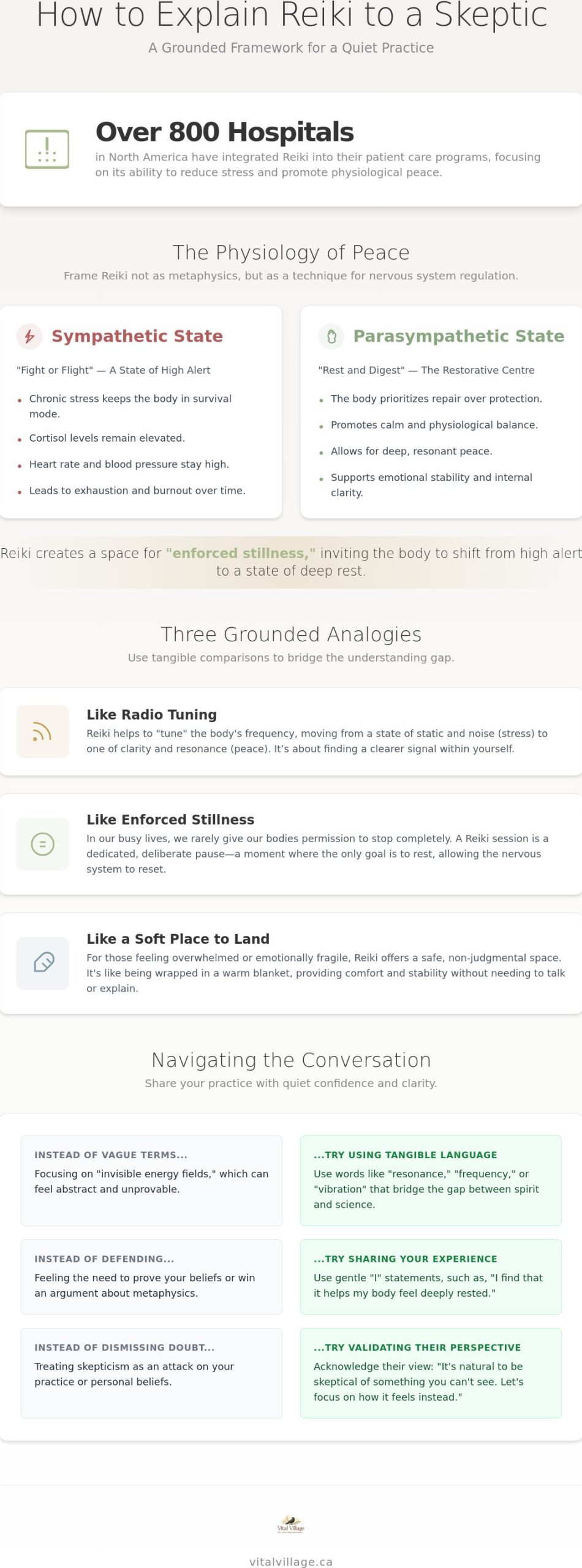
Words like “energy” can sound vague to those who value hard data. Instead, try using terms that feel more tangible. Words like “frequency,” “resonance,” or “vibration” often bridge the gap because they are concepts we already use in music and physics. Focus on the sensory details. Talk about the warmth of a practitioner’s hand, the weight of a heavy blanket, or the profound stillness of the room. Whether they are ready to hear the theory or not, your own calm presence is often the most effective explanation you can offer. If they see you are grounded and clear, they might become curious about the source of that stillness.
Moving Beyond the ‘Woo-Woo’ Stereotypes
It’s easy for people to get caught up in stereotypes of incense-filled rooms and “magic” fixes. Modern Reiki sessions often take place in professional, quiet environments that feel more like a therapeutic clinic or a calm spa. By focusing on the grounded nature of the practice, you strip away the “woo-woo” labels that cause people to tune out. When considering how to explain reiki to a skeptic, remember that you aren’t offering a miracle cure; you’re offering a moment of deep, intentional rest that can favour a sense of internal clarity.
A quiet room. A gentle touch. A moment to breathe.
Approaching the conversation this way allows you to hold space for their doubt without feeling the need to defend your practice. You’re simply sharing a tool for peace that works whether they understand the mechanics or not. This perspective turns a potential argument into a gentle invitation to explore a different way of resting.
The Physiology of Peace: Explaining Reiki Through Nervous System Regulation
The body has a language of its own. It speaks in the rhythm of the heart and the depth of the breath. When you are considering how to explain reiki to a skeptic, the most effective path often leads through the body’s own biological rhythms. Logical minds tend to respect the hard data of the nervous system. By shifting the focus from the invisible to the physiological, you provide a grounded foundation that anyone can understand. It transforms the conversation from a debate about belief into an observation of biology.
Our modern lives often keep us trapped in the sympathetic nervous system, better known as the fight-or-flight response. This is a state of high alert. It is meant for survival. However, when we stay here too long, our cortisol levels remain elevated and our heart rates stay high. Reiki acts as a form of enforced stillness. It is a deliberate pause that allows the body to prioritize repair over protection. Whether you choose to call this energy work or a necessary physiological reset, the result is a deep, resonant peace.
The Science of the Stress Response
Chronic stress often locks the nervous system in a state of constant vigilance. This persistent “on” switch can lead to exhaustion and emotional burnout. During a session, the practitioner’s gentle touch or near-body presence signals safety to the brain. This signal tells the amygdala it can finally stand down. The parasympathetic shift is the body’s natural healing mode. It is in this state of quiet safety that the body can finally begin to lower its guard and find its way back to a stable centre.
Achieving this stability often involves looking at the body’s systems as a whole, which is why practices like 5280 Restorative Medicine focus on helping individuals reclaim their vitality through a functional approach to restorative health.
Heart Rate Variability and Emotional Stability
A regulated nervous system does more than just relax the muscles. It leads to improved heart rate variability, which is a key marker of emotional health and resilience. When the body isn’t pouring its resources into a stress response, the mind finds more room for clarity. The current state of scientific research explores how these non-invasive practices may help manage pain and anxiety by encouraging this internal balance, a fact recognized by nearly 20 per cent of hospitals that have incorporated these services into professional patient care. A skeptic can realize the benefits of deep relaxation even if they don’t yet understand the mechanics of the “how.” The physical results speak for themselves.
If you or someone you know is feeling the weight of a system that won’t shut off, you might schedule a session to begin your own journey toward rest. This practice isn’t about convincing someone of a specific truth; it’s about offering them a soft place to land. It’s an invitation to experience what happens when the body is finally allowed to be still.
Simple Frameworks: Three Grounded Ways to Describe the Experience
Sometimes, the mind needs a familiar image to settle into. When you’re considering how to explain reiki to a skeptic, analogies can serve as a bridge between the abstract and the tangible. You aren’t asking them to adopt a new belief system. You’re simply inviting them to recognize patterns of restoration they already understand from their daily lives. By shifting the focus away from the invisible and toward the familiar, you create a safe space for curiosity to grow.
Think of the ‘Battery Charger’ analogy. We all know the feeling of a phone running on five per cent power. It becomes slow, glitches, and eventually shuts down. Our bodies are much the same. Reiki is like plugging into a steady source of power to restore depleted reserves. It doesn’t add anything foreign to the system. It simply allows the body to return to its full capacity. The ‘Radio Tuning’ analogy is equally helpful. We often live our lives surrounded by the “static” of stress and noise. Reiki is like slowly turning the dial to find the clear signal between the stations. It helps remove that internal interference so your own natural resonance can be felt again.
Finally, consider ‘Cleaning the Clutter.’ A crowded mind is like a messy desk; it’s hard to find what you need. A session helps organize that mental space, creating room for better focus and peace. For small business owners, this same principle applies to financial organization—you can visit Thank Heavens Bookkeeping to get your paperwork tax-ready and reduce professional stress. Encourage the skeptic to focus on the outcome rather than the mechanism. If they feel better after the experience, the technical “how” becomes less important than the tangible results.
Analogies for the Logical Mind
For those who prefer a technical framework, you might compare Reiki to a ‘system defragmentation’ for a computer. It’s a process of reorganizing files so the system runs more efficiently—a concept you might explore further when you check out reisinformatica.com—allowing the body to return to its optimal state. You could also use the ‘theatre’ analogy. Reiki is like lowering the house lights before a play begins. The darkness isn’t the point; the stillness is what allows the performance to finally start. This is about resonance. Think of how your body feels in a quiet, ancient forest compared to a loud, bustling city centre. We naturally respond to the “frequency” of our environment. Reiki simply provides a high-quality environment of stillness for the body to match.
Focusing on the Benefits of Reiki
What the science says about Reiki often points toward its role in supporting the body’s own ability to find balance. Whether the skeptic understands the mechanism or not, they can appreciate the outcome. Most people report a significant shift in their baseline stress levels. You might notice:
- Improved sleep quality and deeper rest.
- Reduced physical tension in the shoulders and jaw.
- Greater mental clarity and improved focus.
Reiki supports the body’s innate wisdom. It helps the system find its own way back to equilibrium. Not a cure. A catalyst. When the body is given the right conditions of stillness, it naturally moves toward health. By using these frameworks, you’ll find that knowing how to explain reiki to a skeptic becomes less about defense and more about shared discovery.
Navigating the Conversation: How to Share Your Practice Without Pressure
Sharing your practice doesn’t have to feel like a sales pitch or a debate. When you’re exploring how to explain reiki to a skeptic, remember that your goal isn’t to convert; it’s to connect. You are simply a witness to your own experience. By adopting the persona of a “Wise Companion,” you can offer your perspective without needing the other person to agree or even understand. This approach honours their autonomy and respects that their skepticism is a valid part of their own journey. It removes the weight of expectation from the conversation, allowing it to remain light and open.
One of the most effective ways to stay grounded is by using “I” statements. Instead of making broad claims about how energy works, focus on your own reality. You might say, “I find that I feel more grounded after a session,” or “I’ve realized that it helps me manage my stress during busy weeks.” These personal truths are not debatable. They are simply your observations. You don’t need to rely on fringe science to prove your point. Your own sense of peace and emotional stability is the most compelling evidence you can provide.
Responding to ‘Is it Just a Placebo?’
It’s common for a skeptic to wonder if the benefits are simply the result of the placebo effect. Rather than dismissing this, you can embrace it. The mind-body connection is a powerful and recognized tool for healing. If a “placebo” results in lower stress, better sleep, and a more regulated nervous system, then it has immense value. You can frame the placebo response as the body’s own intelligence at work; it’s the system responding to a signal of safety and beginning its own repair process. Whether the shift comes from the technique itself or the body’s response to it, the result is a tangible improvement in well-being.
Setting Boundaries for Gentle Dialogue
There may come a point where explaining no longer feels productive. It’s okay to stop. You can handle dismissive comments with grace and quiet strength by simply returning to your own centre. You don’t have to defend your practice against every doubt. Sometimes, the best way to share the value of Reiki is to simply model the peace it brings you. If you are calm, patient, and non-judgmental, people will eventually notice the resonance of that stillness.
Silence is a valid answer. Resonance speaks for itself.
If the conversation feels heavy or strained, it might be time to gently transition. You can always invite them to experience a session for themselves when they feel ready. Vital Village Metaphysical holds space for these curious explorations without any demand for belief. By maintaining these boundaries, you ensure that your practice remains a source of personal strength rather than a point of contention. You are holding space for their questions while remaining firmly rooted in your own clarity.
Inviting a Shared Experience: Next Steps for the Curious
There comes a point where words have done their work and the only thing left is the experience itself. When you are considering how to explain reiki to a skeptic, the most compassionate thing you can offer is a no-strings-attached look at what actually happens during a session. You aren’t asking them to commit to a new philosophy. You’re simply inviting them to notice the difference between a mind that is racing and a body that is finally allowed to be still. It is an invitation to observe the “colour” and quality of their own thoughts before and after a period of intentional quiet.
One of the most grounding realizations for a skeptic is that belief is not a prerequisite for relaxation. The body’s nervous system responds to a safe, quiet environment regardless of what the analytical mind thinks about energy work. Just as you don’t need to understand the mechanics of internal combustion to ride in a car, you don’t need to master the theory of resonance to feel the benefits of a physiological reset. The shift into a restorative state happens naturally when the right conditions are met.
What a Grounded Session Looks Like
For someone who values logic and professional standards, the physical setting of a session provides immediate reassurance. At Vital Village Metaphysical, we focus on creating a “soft place to land” that feels safe and predictable. A typical session involves lying on a comfortable table, fully clothed, often tucked under soft, weighted blankets. There is no pressure to perform or even to stay awake. The practitioner maintains a professional, quiet presence, ensuring that the environment remains a sanctuary for your own internal journey. This structured, respectful approach is why a grounded therapeutic reiki treatment is such an effective starting point for those seeking emotional stability without unnecessary distractions.
A Final Gentle Invitation
Everyone’s path to clarity and peace is unique; there is no rush to find immediate answers or to discard your healthy skepticism. Doubt is often just a sign that you value your own intellectual integrity, and that is something to be honoured. If you feel a quiet pull toward this practice, we encourage you to visit our centre for a consultation where you can ask questions in a non-judgmental space. We invite you to simply notice how you feel in the presence of a practitioner. Sometimes, the most profound part of how to explain reiki to a skeptic isn’t the explanation at all, but the resonance of a calm heart meeting a busy mind. When you are ready, the stillness will be here waiting for you.
Finding Common Ground in Stillness
Finding common ground doesn’t require a shared belief system; it only requires a shared desire for peace. By anchoring your conversations in the tangible reality of nervous system regulation and using familiar analogies, you can demystify the practice without losing its heart. Understanding how to explain reiki to a skeptic is less about winning an argument and more about inviting a quiet curiosity. You’re offering a bridge between the busy, logical mind and the body’s innate need for deep, restorative rest.
At Vital Village, we prioritize professional practitioner training and a focus on nervous system resilience to ensure every session is grounded in safety and clarity. Whether you are seeking stability for yourself or looking to share this path with another, we provide a compassionate, non-judgmental environment for exploration. There is no pressure to understand the “how” when the results of stillness speak for themselves.
Discover a soft place to land with a Therapeutic Reiki Treatment at Vital Village.
Trust in the resonance of your own calm. The right words will come when you speak from a place of quiet confidence.
Frequently Asked Questions
How do you explain Reiki to someone who only believes in science?
You focus on the nervous system. Explain that it is a technique for stress reduction that encourages the body to transition from the sympathetic (fight-or-flight) state into the parasympathetic (rest-and-digest) state. This shift is a measurable physiological event. It leads to lower cortisol levels and a stabilized heart rate. Noting that over 800 hospitals in the United States have integrated this practice into their care programs often helps ground the conversation in a professional context.
Is there any evidence that Reiki actually works?
Clinical research points toward its efficacy in reducing pain, anxiety, and the physical symptoms of stress. While the mechanism of energy is still being studied, the results of the sessions are documented in various healthcare settings. Many individuals realize a significant improvement in their well-being after a session. It is often used as a supportive therapy to help patients manage the emotional and physical toll of chronic illness or recovery.
What is the best analogy for explaining Reiki?
The “system defragmentation” analogy often resonates best with logical minds. Just as a computer reorganizes its files to run more efficiently, a session helps the body organize its internal responses to stress. When you are learning how to explain reiki to a skeptic, you might also use the “battery charger” image. It describes the process of restoring depleted reserves so the body has the power it needs to find its own balance.
Can Reiki help with nervous system regulation?
Yes, it is one of the most significant physiological outcomes of a session. By providing a safe environment and gentle touch, the practitioner signals to the brain that it is okay to lower its guard. This allows the amygdala to stand down and the body to prioritize internal repair. This regulation is essential for maintaining emotional stability and mental clarity in a world that often keeps us in a state of constant vigilance.
What happens if a skeptic tries Reiki and feels nothing?
Feeling nothing is a perfectly normal part of the process. The body still benefits from the period of enforced stillness even if the mind doesn’t perceive a specific sensation or “spark.” Relaxation is a physical event that occurs regardless of belief. The heart rate often slows and muscle tension decreases. You don’t need to feel something dramatic to experience a “soft place to land” and a necessary reset for your system.
How is Reiki different from a massage or meditation?
Reiki is a non-invasive practice that involves no tissue manipulation or physical pressure. Unlike a massage, you remain fully clothed. Unlike meditation, it is a passive experience where you aren’t required to focus your mind or follow a specific technique. It provides a unique space where you can simply be. It allows the body to find its own way back to a centre of gravity without any effort or “doing” on your part.
What are the primary benefits of Reiki for a non-spiritual person?
The primary benefits are rooted in stress reduction and physical recovery. Non-spiritual individuals often report better sleep quality and a noticeable reduction in physical tension in the jaw and shoulders. It helps clear the “mental fog” that comes with chronic stress. By favouring a calmer internal state, it allows for better focus and more balanced emotional responses in daily life. It is a practical tool for modern maintenance; for example, you can discover Sage Creek Pharmacy to find efficient, professional health support in the Winnipeg community.
Can Reiki be explained through the lens of physics?
Yes, it can be framed through the principles of resonance and frequency. When you explore how to explain reiki to a skeptic, you can describe how a practitioner’s calm, stable state helps the client’s own system “tune” itself to a more peaceful frequency. This is similar to how a tuning fork can influence another nearby. It is a subtle interaction of biological fields that encourages the body to match a more harmonious and stable rhythm.